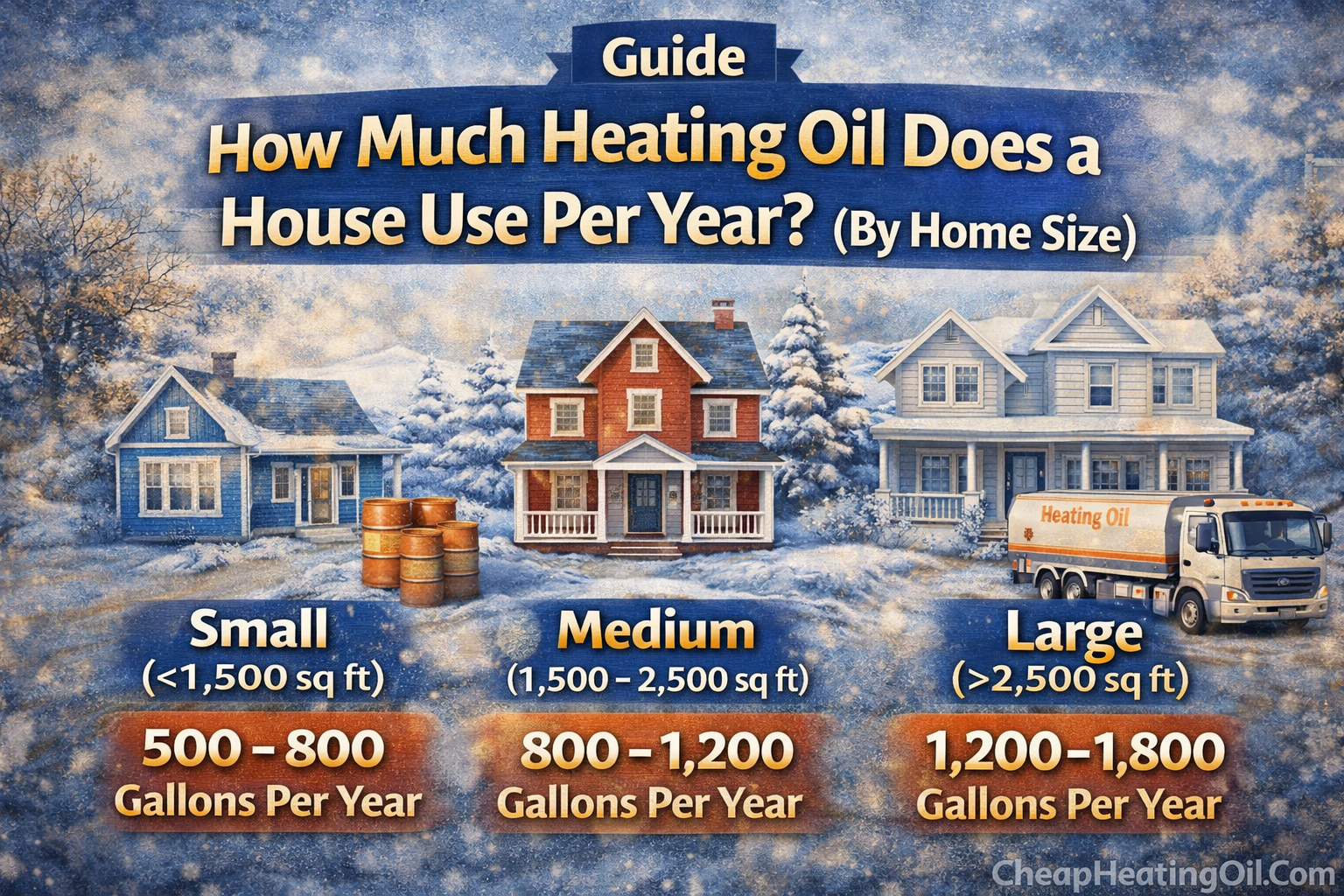
Understanding how much heating oil your home uses each year is the foundation of smart energy budgeting. It tells you how much to budget, when to order, and whether your consumption is higher than it should be. Here is a complete breakdown by home size, state, and home age.
Average Heating Oil Usage in the Northeast
The average Northeast home that uses heating oil as its primary heat source consumes between 700 and 1,000 gallons per heating season. The EIA’s most recent residential energy survey puts the average at approximately 800 gallons per year for a typical single-family home in New England.
At today’s average Northeast price of $5.60 per gallon, that translates to an annual heating cost of roughly $4,480 for the average home.
Usage by Home Size
Home size is the single biggest driver of heating oil consumption. Here are typical annual usage ranges for Northeast homes with average insulation and a modern oil-fired furnace or boiler:
Under 1,000 sq ft (small home or apartment): 400 to 600 gallons per year
1,000 to 1,500 sq ft: 550 to 750 gallons per year
1,500 to 2,000 sq ft: 700 to 900 gallons per year
2,000 to 2,500 sq ft: 850 to 1,100 gallons per year
2,500 to 3,000 sq ft: 1,000 to 1,300 gallons per year
Over 3,000 sq ft: 1,200 to 1,800 gallons per year
These ranges assume average insulation, average winter temperatures for the Northeast, and a furnace or boiler with an annual fuel utilization efficiency (AFUE) rating of 80 to 85 percent — which covers most equipment installed before 2010.
Usage by State
Geography matters. Northern states with longer, colder winters consume significantly more heating oil than southern New England states.
Maine: 900 to 1,100 gallons per year average Vermont: 850 to 1,050 gallons per year average New Hampshire: 800 to 1,000 gallons per year average Connecticut: 700 to 900 gallons per year average Massachusetts: 700 to 900 gallons per year average Rhode Island: 650 to 850 gallons per year average New York: 750 to 1,000 gallons per year average (varies widely by region) New Jersey: 600 to 800 gallons per year average Pennsylvania: 650 to 850 gallons per year average Delaware: 550 to 750 gallons per year average Maryland: 500 to 700 gallons per year average
How Home Age and Insulation Affect Usage
A well-insulated modern home uses dramatically less heating oil than an older home of the same size. Here is how insulation and home vintage affect consumption:
Pre-1980 homes with original insulation: Typically use 20 to 40 percent more oil than the average for their size. Air sealing and insulation upgrades offer the biggest return on investment for these homes.
1980 to 2000 homes: Near average consumption for their size if mechanicals have been updated.
Post-2000 homes: Often use 15 to 25 percent less than average due to better insulation standards and higher-efficiency equipment.
Modern high-efficiency homes (post-2010 with updated HVAC): A high-efficiency condensing oil boiler with an AFUE rating of 90 to 95 percent can reduce consumption by 15 to 20 percent compared to standard equipment.
How to Calculate Your Own Usage
The most accurate way to estimate your annual consumption is to look at your delivery history from the past two or three years. Add up the gallons delivered in each 12-month period from October through September. Average those numbers and you have your baseline annual consumption.
If you do not have that history, check your oil tank gauge at the start and end of each heating season. Track deliveries in between. After one full season you will have an accurate personal benchmark.
Signs Your Usage Is Higher Than It Should Be
If your consumption is significantly above the ranges above for your home size, these are the most likely causes:
An aging furnace or boiler with declining efficiency. Equipment over 15 years old often operates at 70 to 75 percent efficiency, wasting 10 to 15 percent more fuel than a modern unit.
Poor insulation in the attic or basement. Heat rises and escapes through attic insulation gaps. Cold floors from an uninsulated basement affect perceived comfort and cause people to set thermostats higher.
Air leaks around windows, doors, and penetrations. A surprisingly large share of heat loss in older Northeast homes comes from air infiltration rather than insulation.
A thermostat set higher than necessary. Every degree above 68°F adds roughly 3 percent to your heating costs.
How to Reduce Your Annual Usage
The highest-return actions for reducing heating oil consumption are getting a furnace or boiler tune-up annually, sealing air leaks, adding attic insulation if it is below current recommended levels, installing a programmable or smart thermostat, and having your system serviced to verify it is running at its rated efficiency.
A professional energy audit — available in many Northeast states through utility rebate programs — can identify exactly where your home is losing heat and prioritize the investments with the best payback.
Frequently Asked Questions
How many gallons of heating oil does a typical house use per month? During peak heating months (January and February), the average Northeast home burns 150 to 200 gallons per month. During mild shoulder months (October and April), consumption drops to 50 to 100 gallons per month.
How long will 100 gallons of heating oil last? In an average Northeast home in winter, 100 gallons lasts approximately 2 to 3 weeks. In mild weather or a smaller, well-insulated home, it can last 4 to 6 weeks.
What is the average heating oil tank size for a home? The most common residential oil tank sizes in the Northeast are 275 gallons and 330 gallons. Some larger homes have 500-gallon or 1,000-gallon tanks.
How do I know when my tank is running low? Most residential tanks have a float gauge on top that shows approximate level. A good rule of thumb is to order a delivery when your tank reaches the one-quarter mark — typically around 70 gallons in a 275-gallon tank — to ensure you never run out.
Does heating oil go bad if stored in the tank over summer? Heating oil can begin to degrade after 18 to 24 months in storage, particularly if the tank is warm or has water contamination. For most homeowners who use their full tank each winter, this is not a concern. If you are leaving a tank mostly full over a long period, a fuel additive can extend stability.