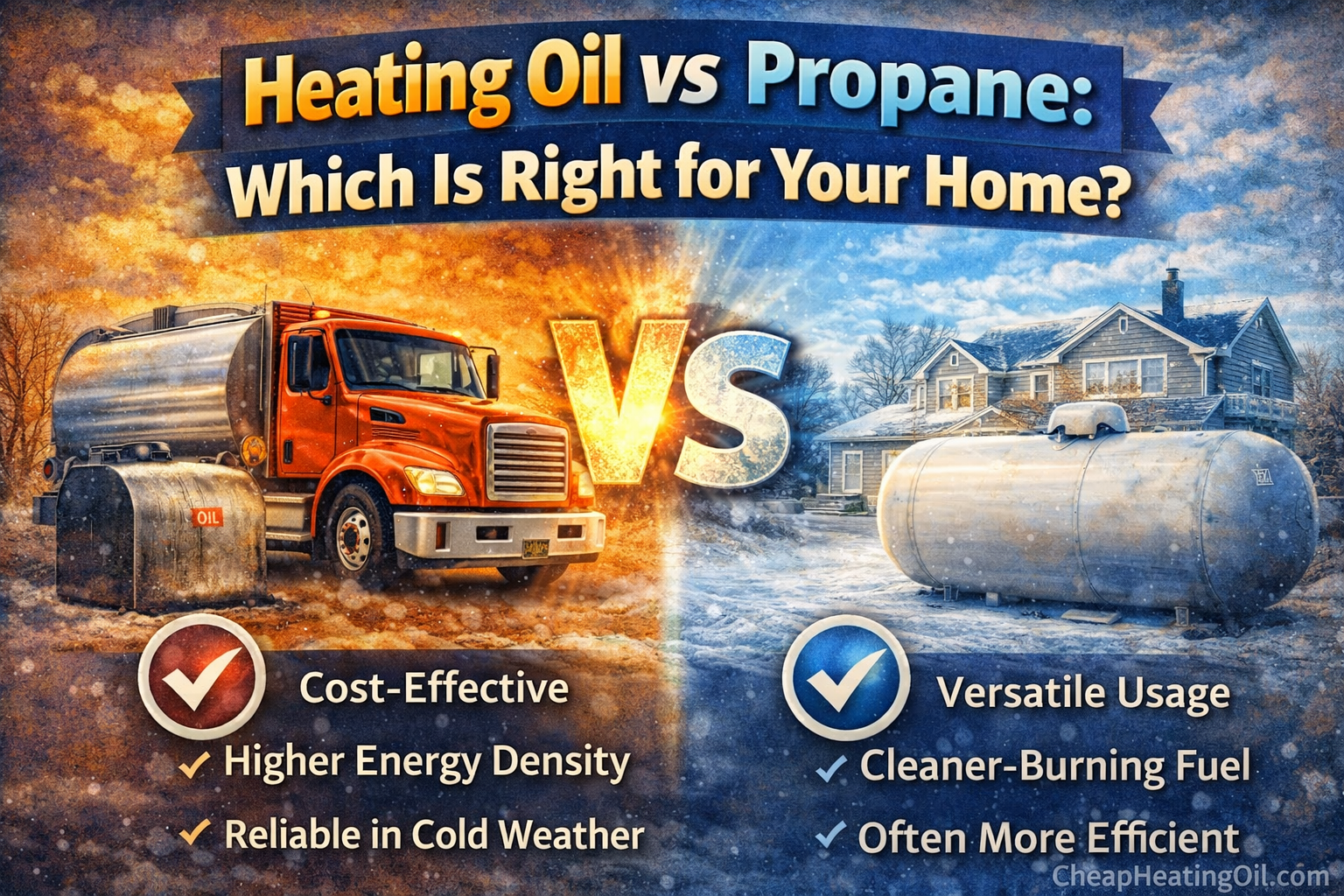
For homes not served by natural gas, the choice often comes down to heating oil versus propane. Both are delivered fuels requiring on-site storage. Both serve the Northeast market well. But they have important differences in cost, infrastructure, and application. Here is a complete comparison.
Current Prices: Heating Oil vs Propane
To compare these fuels meaningfully, you need to account for energy content. Heating oil contains approximately 138,500 BTUs per gallon. Propane contains approximately 91,500 BTUs per gallon — about two-thirds as much energy per gallon.
At the current Northeast average heating oil price of $5.60 per gallon, delivered cost per million BTUs from oil (at 85 percent efficiency) is approximately $47.60.
Northeast residential propane prices in early 2026 average approximately $3.50 to $4.50 per gallon depending on location and delivery volume. At $4.00 per gallon with a 95 percent efficient propane furnace, the cost per million BTUs is approximately $46.20.
By this calculation, the two fuels are currently competitive on a per-BTU basis in the Northeast, with propane slightly cheaper in some markets and oil slightly cheaper in others. This is not always the case — the relative price of the two fuels shifts with crude oil markets and propane supply conditions.
Infrastructure Differences
Heating oil: Your oil tank is typically owned by you (or in some cases by the dealer). Standard residential tanks hold 275 to 330 gallons. Delivery trucks can fill the tank quickly through an exterior fill pipe. The tank is non-pressurized and relatively simple to maintain.
Propane: Propane tanks are pressurized vessels, which creates different storage, safety, and regulatory requirements. Propane tanks are often owned by the dealer and leased to the homeowner — a practice that can tie you to a single supplier and limit your price shopping flexibility. Tank sizes range from 120 gallons to 1,000 gallons for residential use, with most whole-home heating systems using 500-gallon tanks.
Applications Where Propane Has an Advantage
Propane’s lower storage cost and pressurized delivery infrastructure make it the preferred choice for several applications where heating oil is less practical.
Whole-home backup generators almost universally use propane rather than diesel or heating oil, because propane stores indefinitely without degradation and feeds directly to the generator without pumping. If you want a propane generator with your heating system, a shared propane tank serves both applications efficiently.
Propane ranges, dryers, fireplaces, and outdoor grills are all natural complements to a propane heating system. Homes that run multiple propane appliances benefit from the infrastructure investment more than homes using propane only for space heating.
In very cold climates, propane has a slight advantage in supply reliability. Heating oil can gel in extreme cold below -10°F unless treated with anti-gel additives, though this is rarely an issue in practical Northeast conditions. Modern #2 heating oil with winter additives performs reliably at temperatures Northeast homeowners normally encounter.
Applications Where Heating Oil Has an Advantage
For whole-home space heating, heating oil systems are more widely supported in the Northeast. The network of service technicians, parts supply, and dealer infrastructure for oil heat is denser in the Northeast than the propane service network.
Oil equipment tends to have a longer service life than propane equipment in high-demand whole-home heating applications. High-quality cast-iron oil boilers routinely last 30 years or more with proper maintenance.
The flexibility of the COD (cash on delivery) market for heating oil — with hundreds of dealers competing for business in most Northeast markets — gives oil customers more price shopping options than propane customers, who are often tied to the company that owns their tank.
Switching Between Fuels
Switching from heating oil to propane (or vice versa) requires equipment replacement — oil furnaces and boilers cannot burn propane and propane equipment cannot burn oil. The conversion cost is similar to an oil-to-gas conversion: $4,000 to $12,000 depending on the scope of work.
As with oil-to-gas conversions, the right time to consider switching is when your current equipment is aging and due for replacement anyway. If your oil boiler is 15 years old and you are evaluating options, getting quotes for both oil equipment replacement and propane conversion gives you a real cost comparison.
Frequently Asked Questions
Is propane cheaper than heating oil right now? In early 2026, the two fuels are competitive on a per-BTU basis in most Northeast markets. Propane is modestly cheaper in some areas; oil is modestly cheaper in others. Check current prices for both fuels in your specific area.
Can I use the same tank for heating oil and propane? No. Heating oil and propane require different tank types, fittings, and delivery equipment. They are not interchangeable.
Does propane burn cleaner than heating oil? Propane produces slightly lower carbon dioxide emissions per BTU than heating oil and virtually no particulate emissions. However, modern Bioheat oil blends (B20 and above) close the environmental gap significantly.
Which fuel is more common in the Northeast? Heating oil is significantly more common than propane for residential space heating in the Northeast. The EIA estimates approximately 4.5 million Northeast homes use heating oil compared to roughly 2 million using propane for space heating.
What happens to propane in extreme cold? Propane can have reduced vaporization pressure in very cold temperatures, potentially reducing burner performance if the tank is nearly empty and ambient temperatures are extremely low. Keeping propane tanks above 20 percent full in extreme cold prevents most performance issues.