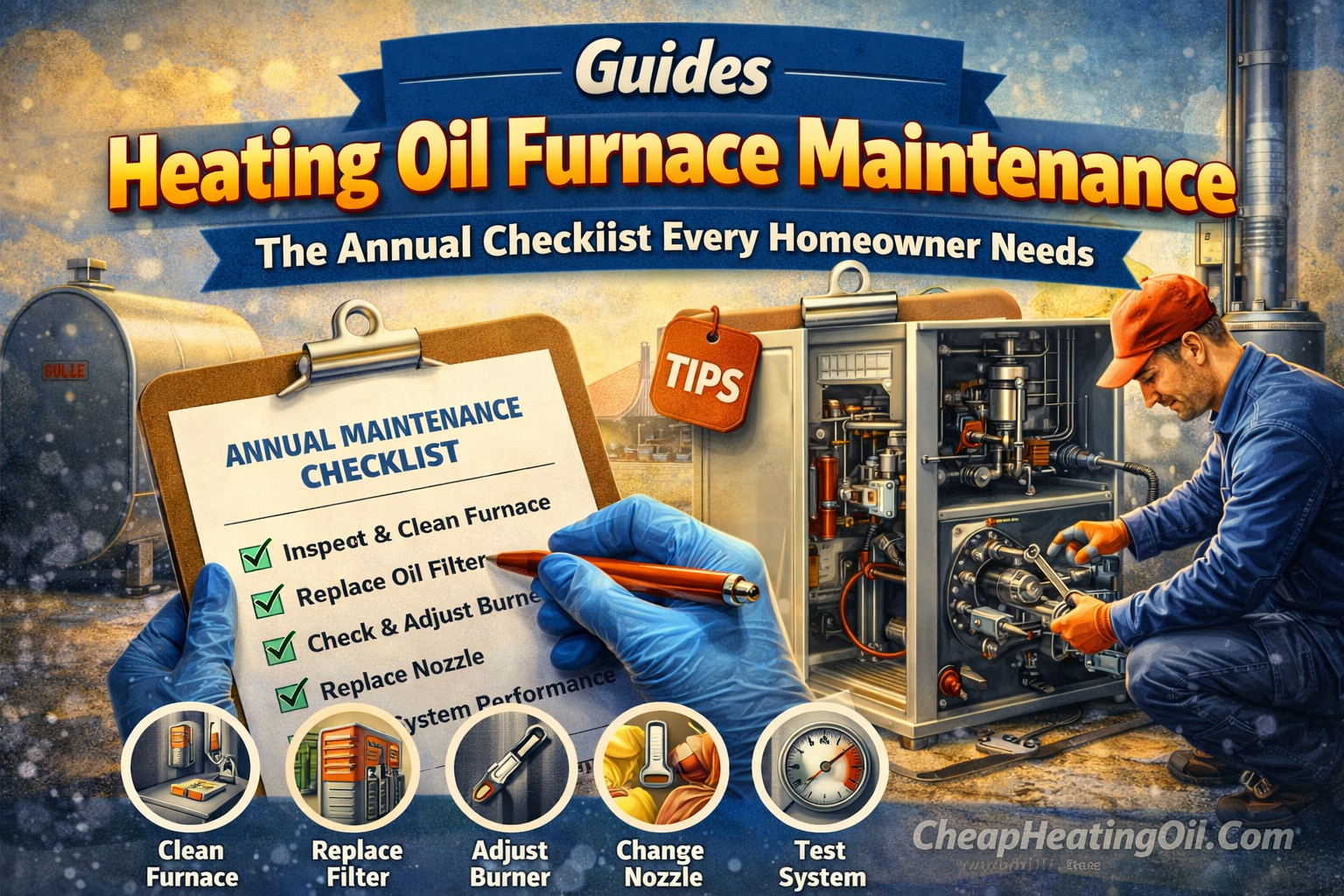
A well-maintained oil furnace or boiler runs more efficiently, lasts longer, and costs less to operate than one that is neglected. Annual professional service plus regular homeowner maintenance is the combination that gets you 25 to 30 years out of a quality system. Here is the complete checklist.
Why Annual Tune-Ups Pay for Themselves
A dirty or poorly tuned oil burner can run at 70 to 75 percent efficiency rather than its rated 85 to 87 percent. On an 800-gallon annual consumption, that represents approximately 100 to 130 gallons of wasted fuel — worth $560 to $730 at current prices. A professional tune-up costs $100 to $200. The math is straightforward.
Beyond fuel savings, annual service catches small problems before they become expensive failures. A $30 nozzle replacement found at a tune-up is better than a $400 emergency service call at midnight in January.
Annual Professional Service: What It Includes
Schedule professional service every fall before the heating season begins — typically September or October when technicians are less busy than in December and January. A standard oil heating service includes:
Burner inspection and cleaning: The technician inspects the oil burner for carbon deposits, corrosion, and wear. They clean the combustion chamber and heat exchanger.
Nozzle replacement: The nozzle atomizes the oil as it enters the combustion chamber. Nozzles wear and should be replaced annually for consistent performance and clean combustion.
Filter replacement: The oil filter prevents sediment from reaching the burner. Annual replacement is standard.
Electrodes inspection and adjustment: The electrodes ignite the oil-air mixture. They are inspected for wear and carbon buildup and adjusted to specification.
Combustion analysis: A technician with a combustion analyzer measures oxygen levels, carbon dioxide, carbon monoxide, and stack temperature. These measurements confirm that the burner is running at optimal efficiency.
Flue and chimney inspection: The technician checks the flue pipe connections and inspects for soot buildup or blockages that could cause carbon monoxide to back-draft into the home.
Heat exchanger inspection: Cracks in the heat exchanger can allow combustion gases including carbon monoxide to enter the living space. Annual inspection is critical for safety.
Controls and safety devices test: The aquastat, limit controls, and safety shutoffs are tested to confirm they operate correctly.
Homeowner Maintenance: Monthly During Heating Season
Check the air filter on forced-air systems: Oil-fired forced-air furnaces have air filters that should be checked monthly and replaced when dirty — typically every 1 to 3 months during heating season. A clogged filter reduces airflow, decreases efficiency, and stresses the blower motor.
Listen for unusual noises: Banging, rumbling, or squealing sounds from your furnace or boiler warrant a service call. Early diagnosis of a developing problem is always cheaper than emergency repair.
Check the flame through the sight glass: Oil burners have a sight glass that allows you to observe the flame without opening the unit. A bright orange or yellow flame is normal. A smoky, flickering, or orange with black streaks flame suggests a problem.
Monitor fuel consumption: If your tank seems to be emptying faster than usual without a change in weather or thermostat settings, investigate. Higher than normal consumption can indicate inefficient combustion, air leaks in the ductwork, or equipment problems.
Homeowner Maintenance: Annual Before Heating Season
Bleed the radiators on a hot-water baseboard or radiator system. Air trapped in the system reduces heat output. Bleeding — opening the small valve on each radiator until water (not air) comes out — takes 15 minutes for a whole house and noticeably improves performance.
Check the expansion tank pressure on a boiler system. The expansion tank absorbs pressure fluctuations as water heats and cools. A waterlogged expansion tank causes pressure relief valve trips and reduced efficiency.
Test your carbon monoxide detector and smoke detector batteries. This is non-negotiable for any home with combustion heating.
Clear the area around your furnace or boiler. Combustion appliances need clear airflow and an unobstructed flue. Do not store materials within three feet of the unit.
When to Call for Service Immediately
Call your dealer or a heating technician immediately — not at the next scheduled maintenance — if you experience: the burner firing but no heat produced, a persistent oil smell in the house, the system shutting off and refusing to restart, visible soot or smoke around the furnace or flue connections, or your carbon monoxide detector alarming.
Carbon monoxide from a cracked heat exchanger or flue back-draft is a life-safety issue. If your CO detector sounds, leave the house, call 911, and do not return until emergency responders have cleared it.
Frequently Asked Questions
How often should an oil furnace be serviced? Annually, ideally in late summer or early fall before the heating season. Systems over 15 years old benefit from service every year without exception.
How long does an oil furnace tune-up take? A standard oil furnace or boiler tune-up takes 1 to 2 hours depending on the system’s condition and the scope of work.
What does an oil furnace tune-up cost? In the Northeast, a standard oil furnace or boiler tune-up typically costs $100 to $200. Service contracts that include the annual tune-up plus emergency repair coverage typically run $150 to $300 per year.
Can I do my own oil furnace maintenance? Homeowners can handle air filter replacements, system resets after lockouts, bleeding radiators, and general cleaning around the unit. Combustion analysis, nozzle replacement, electrode adjustment, and heat exchanger inspection require a licensed technician.
What causes an oil furnace to stop working? The most common causes are: running out of oil, a tripped safety switch (press the red reset button — once only), a clogged nozzle or filter, a faulty thermostat, or an ignition failure. If a single reset button press does not restore operation, call a technician.