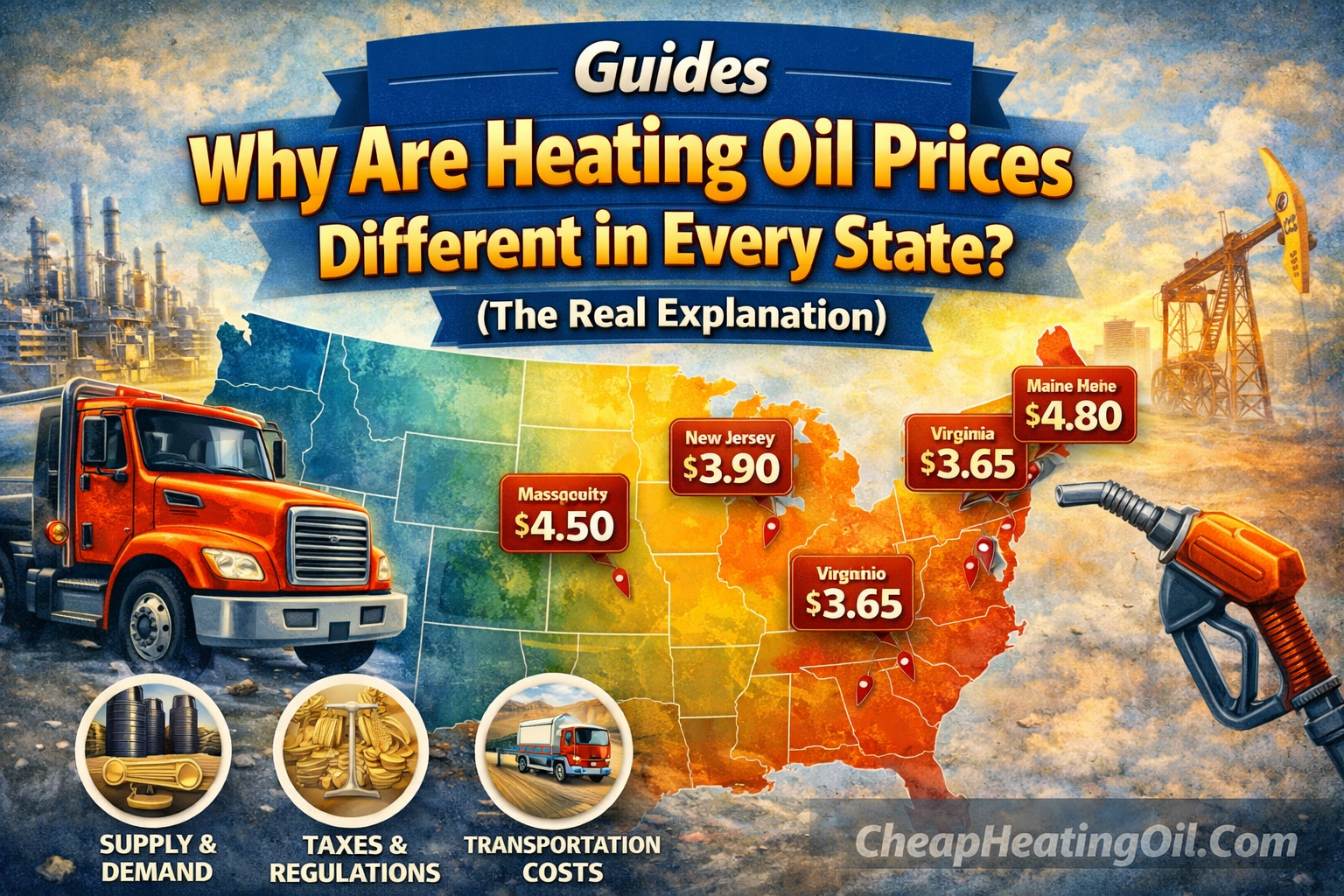
If you have ever compared heating oil prices between states and wondered why Pennsylvania is 40 cents cheaper than New York or why Connecticut and Massachusetts prices diverge, the answer involves several interconnected factors. Here is the real explanation.
Proximity to Refining Infrastructure
The single biggest driver of state-level price variation is distance from the refinery and terminal network. Heating oil is refined from crude oil at facilities primarily located in New Jersey, Pennsylvania, and along the Gulf Coast. From there it moves by pipeline and barge to regional terminals, and from terminals to dealer trucks to your home.
Pennsylvania benefits from being closer to major refining centers than most other Northeast states. This shorter supply chain means lower transportation costs, which translate directly to lower retail prices. Maine, Vermont, and northern New Hampshire sit at the far end of the supply chain — heating oil reaches them after additional pipeline and truck transport legs, each adding cost.
Terminal Infrastructure and Competition
States and regions with more terminal infrastructure and more competing dealers have lower prices. Connecticut and Massachusetts have dense networks of heating oil terminals and thousands of competing dealers, which keeps prices competitive. More rural states like Vermont and Maine have fewer terminals, fewer dealers, and consequently less price competition.
The concentration of dealers in a market affects prices directly: in greater Hartford there may be 20 dealers competing for your business. In a rural Vermont town, there may be two. Competition — or the lack of it — shows up immediately in the price per gallon.
State Taxes and Fees
Heating oil is subject to state taxes that vary considerably across the Northeast. Most Northeast states exempt residential heating oil from sales tax, but motor fuel taxes and environmental fees differ by state. Heating oil used for residential heating is exempt from federal excise tax, but state-level fees and environmental charges vary.
New York’s various state taxes and fees on energy products contribute to its position at the high end of Northeast pricing. Pennsylvania’s lower tax burden on heating fuels is one reason it consistently has some of the lowest retail prices in the region.
Delivery Geography and Logistics
Even within a single state, delivery costs vary by location. A dealer serving a densely populated suburb can make 15 to 20 deliveries per day from a single terminal run. A dealer serving a rural area might make 5 to 8 deliveries, with longer drives between stops. The cost per delivery is higher for rural customers, and that cost is reflected in the price per gallon.
This is why prices within the same state can vary by 20 to 30 cents per gallon between a densely populated city and a rural town 60 miles away, even when both areas are served by the same regional terminal network.
State Energy Efficiency Programs and Regulation
Some states have active programs that affect the heating oil market. Massachusetts, Connecticut, and New York have state-run energy efficiency programs, appliance rebate programs, and clean heat standards that influence dealer practices and product mix. Massachusetts’s Mass Save program provides rebates for high-efficiency oil equipment and Bioheat adoption, which affects the market structure in ways that can modestly influence retail prices.
Why City-Level Prices Differ Within a State
Within a single state, city-level price differences come primarily from local dealer density and competition. A city with 10 dealers competing for customers will have sharper pricing than one with 2 or 3. Delivery route density matters too — a dealer who can fill 20 tanks in a single neighborhood run has lower per-delivery costs than one driving 10 miles between stops.
Port cities and cities near terminals — like Providence in Rhode Island, or cities in northern New Jersey — often have some of the most competitive prices in their states because dealers have low transport costs and face intense competition.
How to Use This Information
Understanding what drives price variation helps you set realistic expectations. If you live in rural Vermont, you are structurally going to pay more for heating oil than someone in suburban Connecticut, regardless of how aggressively you shop. The correct benchmark for your prices is not the statewide average or the national average — it is the range of prices actually available in your zip code and the towns immediately around you.
This is why zip-code-level price comparison is more useful than state-level averages. The relevant market for your heating oil purchase is the set of dealers who can and do serve your specific address, not everyone in your state.
Frequently Asked Questions
Why is Pennsylvania always the cheapest state for heating oil? Pennsylvania benefits from proximity to major refining and terminal infrastructure along the Delaware Valley and Gulf Coast pipeline connections. Lower transportation costs and favorable state tax treatment combine to make it consistently one of the most competitive heating oil markets in the Northeast.
Why is New York heating oil so expensive? New York pricing reflects a combination of factors: higher state taxes and fees, significant geographic diversity (Manhattan versus the North Country have very different supply chains), and in New York City, the specific challenges of urban delivery logistics.
Does heating oil cost more in rural areas? Yes, typically. Rural areas have fewer competing dealers and higher per-delivery costs, both of which push retail prices above urban and suburban levels.
Why do prices change daily? Retail heating oil prices are closely tied to wholesale distillate markets, which trade daily based on crude oil prices, inventory reports, weather forecasts, and global demand signals. Most dealers update their rack-plus-margin prices daily as their own costs change.
Is it worth driving to another state to buy heating oil? No — you cannot transport fuel oil yourself in meaningful quantities, and heating oil is always delivered to your home by a dealer. The state price difference applies to who delivers to your specific address, not where you go to buy it.