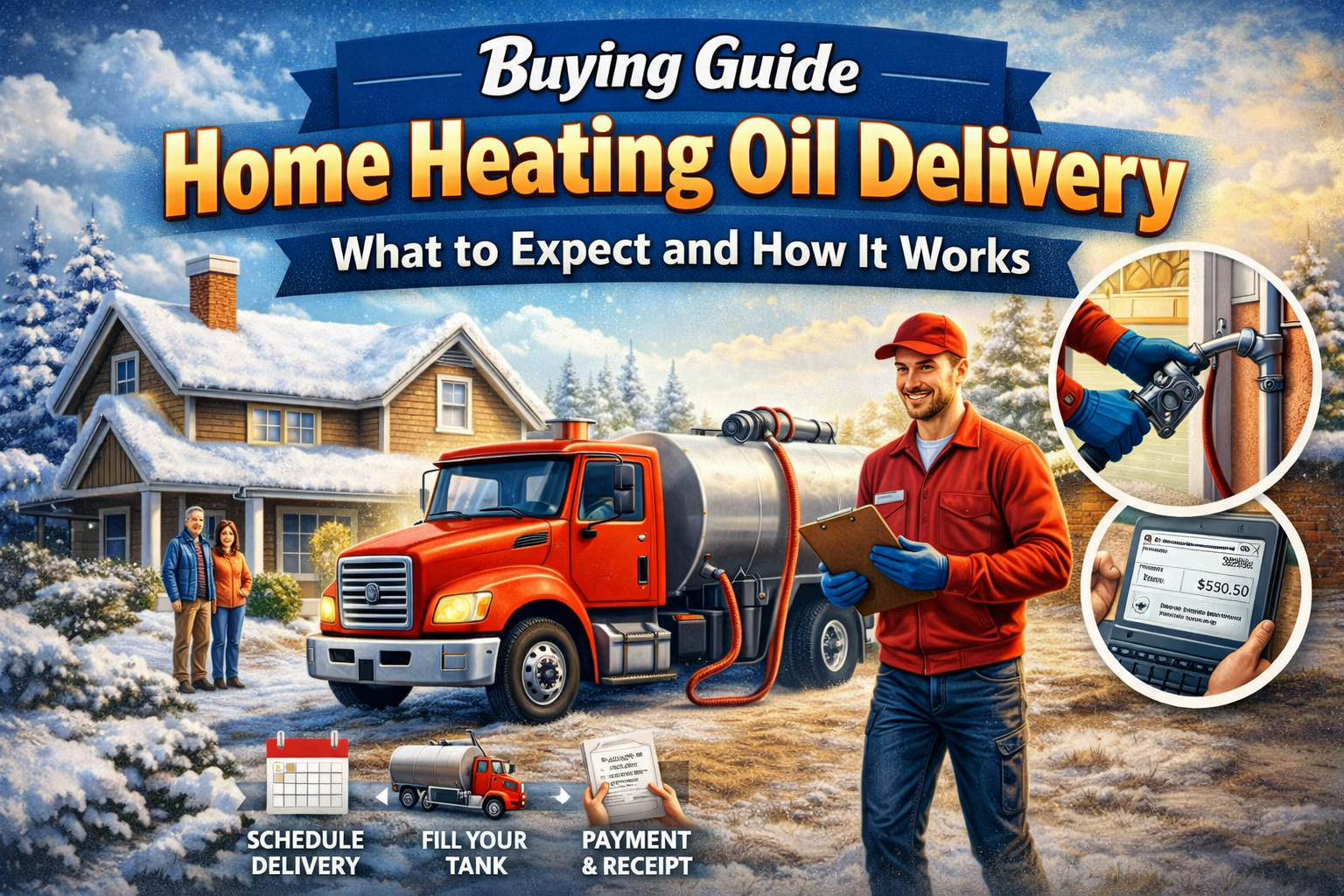
If you are new to heating with oil or just moved to the Northeast, the heating oil delivery process can feel unfamiliar. Here is exactly how it works, from placing your first order to the truck arriving at your door.
The Two Ways to Order Heating Oil
Will-call (COD) ordering: You monitor your own tank gauge and call your dealer when you need a delivery. Most dealers ask for 24 to 72 hours notice for a standard will-call delivery. You pay on delivery — by cash, check, or credit card depending on the dealer.
Automatic delivery: Your dealer tracks your estimated consumption using degree-day calculations — a formula based on outdoor temperature and your home’s typical burn rate. They deliver before your tank runs low without you needing to call. You pay per delivery or through a budget plan with monthly payments.
Most homeowners start with one or the other and stick with it, but you can switch between models when you change dealers or when your situation changes.
How to Place a Will-Call Order
Call your dealer’s main number — most have a 24-hour line or answering service for delivery requests. Have your address, the name on the account, your current tank gauge reading, and your preferred payment method ready. The dispatcher will give you an estimated delivery window.
Increasingly, dealers offer online ordering through their websites or a portal. Some accept text or email orders for existing customers.
Typical Delivery Timeframes
In normal weather conditions, most Northeast dealers can deliver within 1 to 3 business days of a will-call order. During cold snaps or after major storms, delivery windows stretch. During an extreme cold event — the kind that sends the whole region scrambling for fuel at once — wait times can reach 5 to 7 days for non-emergency will-call orders.
This is why the rule of thumb is to order when your tank reaches 1/4 full, not when it reaches empty. The 1/4 tank mark gives you 3 to 7 days of reserve depending on how cold it is — enough buffer to wait for a non-emergency delivery.
What Happens on Delivery Day
The delivery driver arrives with a tank truck — typically holding 1,500 to 3,000 gallons — and parks at the curb or in your driveway. You do not need to be home for a standard delivery. The driver connects a hose to your outdoor fill pipe — a 3-inch pipe typically located on the exterior foundation wall — and pumps oil directly into your tank.
The driver records the number of gallons delivered on a printed delivery ticket, which they either leave at your door or mail with your invoice. If you were home, you sign the ticket. If not, it goes on the door.
Delivery takes 5 to 15 minutes depending on how much oil is being delivered.
How to Prepare Your Home for Delivery
Clear snow and ice from around your fill pipe before winter. The fill pipe is the driver’s access point — if they cannot reach it safely, they cannot complete the delivery.
Make sure your driveway and any path to the fill pipe is accessible for the truck. Large delivery trucks need reasonable clearance and cannot navigate tight turns or unpaved surfaces in wet conditions.
If you have a dog, confine them during delivery. Drivers encounter dogs at virtually every other property and it is a safety issue for them and a liability issue for you.
Make sure your address is visible from the street. Drivers making dozens of deliveries per day appreciate not having to search for house numbers.
What Happens If You Run Out of Oil
Running out of oil — called “running dry” in the industry — is more than an inconvenience. When your tank empties completely, air enters the fuel line. Your furnace or boiler will attempt to fire, fail, and lock out. Restarting requires a service technician to prime the fuel line and reset the system — a service call that costs $75 to $150 on top of the emergency delivery charge.
Emergency delivery — same-day or next-day service for out-of-oil situations — typically carries a surcharge of $50 to $150 over the standard delivery price. In extreme cold during a regional shortage, some dealers charge more.
The practical lesson: set a reminder or use a price alert service to keep your tank above 1/4 full through the heating season.
Minimum Delivery Quantities
Most dealers have a minimum delivery quantity of 100 to 150 gallons. Some have minimums as high as 200 gallons. If your tank has space for less than the minimum, some dealers will still deliver at the minimum (filling your tank and potentially overfilling slightly) while others will not deliver until you have enough space.
For a 275-gallon tank, this means you typically need to be below 3/4 full to receive a standard delivery. If your tank is reading 3/4, wait until it drops to 1/2 before ordering.
Frequently Asked Questions
Do I need to be home for a heating oil delivery? No — the fill pipe is exterior and accessible without entering your home. Most deliveries are completed without the homeowner present. Leave any special instructions with your dealer when you place the order.
How do I know how many gallons were delivered? The driver’s meter records the exact gallons pumped. The delivery ticket left at your door shows the gallons delivered, the price per gallon, and the total charge. If you were not home, this is your receipt.
Can heating oil be delivered in any weather? Deliveries continue in most weather conditions. Heavy snow, icy roads, or unsafe conditions may delay deliveries. Your dealer will call or leave a message if a scheduled delivery needs to be rescheduled due to weather.
What if my delivery is late? Call your dealer’s customer service line. A simple inquiry about delivery status is routine and usually gets a quick answer. If your tank is very low and your delivery is significantly overdue, let them know — most dealers will prioritize an at-risk customer.
Can I order heating oil online? Yes — an increasing number of Northeast dealers accept online orders through their websites or third-party platforms. COD platforms like those found through dealer comparison sites let you browse prices and order from multiple dealers in your area.